Back pain is one of the most common health complaints among adults. However, not all back pain originates from muscles, joints, or the spine. In many cases, severe pain in the lower back or side may actually be caused by kidney stones — a painful urological condition that often requires medical attention.
Because the symptoms can sometimes overlap, many people confuse kidney stone pain with regular back pain. Understanding the difference is important because delayed diagnosis of kidney stones can lead to complications such as urinary blockage, infection, or kidney damage.
In this article, we explain how to differentiate kidney stone pain from back pain, their symptoms, causes, warning signs, and when to see a urologist.
What Are Kidney Stones?
Kidney stones are hard mineral and salt deposits that form inside the kidneys. They develop when urine contains high levels of minerals such as calcium, oxalate, or uric acid.
These stones may remain inside the kidney or travel through the urinary tract. Pain usually begins when a stone blocks urine flow or moves into the ureter.
Common Types of Kidney Stones
- Calcium stones
- Uric acid stones
- Struvite stones
- Cystine stones
Kidney stones are increasingly common due to dehydration, poor diet, obesity, and lifestyle changes.
What Is Regular Back Pain?
Back pain usually develops from problems related to:
- Muscle strain
- Poor posture
- Slipped disc
- Sciatica
- Arthritis
- Spinal injuries
- Sedentary lifestyle
Most cases of back pain are musculoskeletal in origin and improve with rest, posture correction, and physiotherapy.
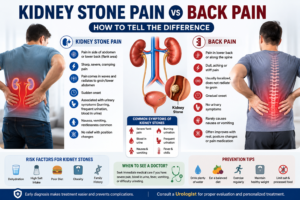
Kidney Stone Pain vs Back Pain: Major Differences
Understanding the location, type, and associated symptoms can help identify the actual cause of pain.
| Feature | Kidney Stone Pain | Regular Back Pain |
| Pain Location | Side of abdomen, flank, lower back | Lower back or spine |
| Type of Pain | Sharp, severe, cramping | Dull, aching, stiffness |
| Pain Movement | Radiates to groin or lower abdomen | Usually stays localized |
| Onset | Sudden | Gradual |
| Position Changes | No relief with posture changes | Often improves with rest/posture |
| Urinary Symptoms | Common | Usually absent |
| Nausea/Vomiting | Common | Rare |
| Fever | Possible with infection | Rare |
Where Is Kidney Stone Pain Felt?
Kidney stone pain usually starts in:
- The side of the abdomen (flank pain)
- Lower back below the ribs
- One side of the body
As the stone moves, pain may travel toward:
- Lower abdomen
- Groin
- Genital area
This moving pattern of pain is a classic sign of kidney stones.
Characteristics of Kidney Stone Pain
Kidney stone pain is often described as:
- Sharp
- Intense
- Cramping
- Wave-like
- Unbearable
The pain may come and go in waves and often becomes severe suddenly.
Many patients feel restless and unable to sit comfortably during an attack.
Characteristics of Muscular or Spine-Related Back Pain
Regular back pain is usually:
- Dull or aching
- Related to movement
- Triggered by lifting weight or poor posture
- Worse after prolonged sitting
- Improved by rest or physiotherapy
Pain may increase while bending, twisting, or standing for long periods.
Symptoms That Suggest Kidney Stones Instead of Back Pain
The following symptoms strongly indicate kidney stones:
Burning Urination
Pain or burning sensation while passing urine.
Blood in Urine
Urine may appear pink, red, or brown.
Frequent Urination
Feeling the need to urinate repeatedly.
Nausea and Vomiting
Common during severe kidney stone attacks.
Fever and Chills
May indicate urinary infection — a medical emergency.
Difficulty Passing Urine
Large stones can block urine flow.
What Causes Kidney Stones?
Several factors increase the risk of kidney stone formation.
Dehydration
Not drinking enough water is one of the biggest causes.
High Salt Intake
Excess salt increases calcium in urine.
Excess Oxalate-Rich Foods
Such as spinach, nuts, and chocolate.
Obesity
Weight gain increases stone risk.
Family History
Genetics can play a role.
Low Physical Activity
Sedentary lifestyle affects metabolism and hydration.
What Causes Regular Back Pain?
Back pain can result from:
- Muscle overuse
- Poor posture
- Long sitting hours
- Heavy lifting
- Disc problems
- Osteoarthritis
- Lack of exercise
Unlike kidney stones, spinal back pain is often related to physical movement.
When Should You Suspect a Kidney Stone?
You should consider kidney stones if:
- Pain is sudden and severe
- Pain radiates to the groin
- You notice blood in urine
- Urination becomes painful
- Pain comes in waves
- You feel nauseous or restless
These symptoms require evaluation by a urologist.
Can Kidney Stone Pain Feel Like Muscle Pain?
Yes, in early stages kidney stone discomfort may feel like mild muscle pain or back stiffness. However, as the stone moves, symptoms usually become sharper and more severe.
This is why many patients initially ignore kidney stones thinking it is “normal back pain.”
How Are Kidney Stones Diagnosed?
Ultrasound
Commonly used to detect stones.
CT Scan
Highly accurate for stone size and location.
Urine Test
Checks infection and blood in urine.
Blood Tests
Assess kidney function and mineral levels.
How Is Back Pain Diagnosed?
Doctors may recommend:
- Physical examination
- X-rays
- MRI scan
- CT scan
- Nerve evaluation
Diagnosis depends on symptoms and movement-related findings.
Treatment for Kidney Stones
Treatment depends on stone size and symptoms.
Small Stones
May pass naturally with:
- Increased water intake
- Pain medications
- Medical therapy
Larger Stones
May require:
- Laser stone removal
- URS (Ureteroscopy)
- PCNL surgery
- Shock wave lithotripsy (ESWL)
Modern minimally invasive treatments provide faster recovery and less pain.
Treatment for Regular Back Pain
Most back pain improves with:
- Rest
- Physiotherapy
- Exercise
- Posture correction
- Pain relievers
- Weight management
Severe spinal conditions may occasionally require surgery.
Can Kidney Stones Be Prevented?
Yes. Lifestyle changes significantly reduce recurrence risk.
Prevention Tips
- Drink 2.5–3 liters of water daily
- Reduce salt intake
- Avoid excessive junk food
- Maintain healthy weight
- Limit sugary beverages
- Exercise regularly
Patients with recurrent stones should undergo metabolic evaluation.
When Should You See a Urologist Immediately?
Seek urgent medical care if you have:
- Severe flank pain
- Blood in urine
- Fever with pain
- Vomiting
- Difficulty urinating
- Recurrent kidney stones
Ignoring symptoms can lead to kidney infection or urinary obstruction.
Final Thoughts
Kidney stone pain and regular back pain may sometimes feel similar, but there are important differences. Kidney stone pain is typically sharp, sudden, and associated with urinary symptoms, while muscular back pain is usually movement-related and improves with rest.
Recognizing these warning signs early can help patients receive timely treatment and avoid serious complications.
If you are experiencing severe side or lower back pain along with urinary symptoms, consult a urologist for proper diagnosis and treatment.
FAQs
How do I know if my pain is from a kidney stone or back pain?
Kidney stone pain is usually severe, sudden, and associated with urinary symptoms such as burning urination or blood in urine.
Can kidney stone pain come and go?
Yes. Kidney stone pain often occurs in waves as the stone moves through the urinary tract.
Does back pain from kidney stones worsen with movement?
Not usually. Unlike muscular pain, kidney stone pain does not significantly improve with posture changes.
Can kidney stones cause lower back pain on both sides?
Usually, kidney stone pain occurs on one side depending on the affected kidney.
What is the fastest way to diagnose kidney stones?
A CT scan is one of the most accurate tests for diagnosing kidney stones.