Kidney stones are among the most common conditions affecting the urinary system. While some stones remain unnoticed and pass naturally through urine, others can cause intense pain, urinary problems, infections, and complications that may affect kidney function.
One of the biggest challenges with kidney stones is that their symptoms can appear suddenly. A person may feel perfectly healthy and then develop severe pain in the back or side of the abdomen. In other cases, symptoms may be mild and easily confused with muscle pain, digestive problems, or a urinary tract infection.
Understanding the early symptoms of kidney stones can help people recognise when medical evaluation is necessary and when urgent treatment may be required.
Although not every kidney stone needs surgery, stones that obstruct urine flow, cause infection, or lead to persistent symptoms may require medical intervention.
This article explains seven important warning signs of kidney stones, their causes, available diagnostic tests, treatment options, and when you should consult a urologist.
What Are Kidney Stones?
Kidney stones, medically known as renal calculi or nephrolithiasis, are hard deposits formed from minerals and salts present in urine.
Normally, urine contains substances that help prevent minerals from crystallising. However, when certain minerals become highly concentrated, crystals can form and gradually develop into stones.
Kidney stones vary in size, ranging from tiny particles to stones several centimetres across.
The most common types include:
- Calcium stones: Usually composed of calcium oxalate or calcium phosphate. These are the most common kidney stones.
- Uric acid stones: Associated with acidic urine and certain metabolic conditions.
- Struvite stones: Often associated with infections caused by specific bacteria.
- Cystine stones: Uncommon stones that develop in people with a hereditary condition called cystinuria.
Kidney stones may remain inside the kidney without causing symptoms. Pain often develops when a stone moves into the ureter, the narrow tube connecting the kidney to the urinary bladder, and obstructs urine flow.
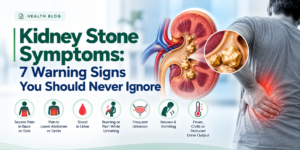
7 Warning Signs of Kidney Stones
- Sudden, Severe Pain in the Back or Side
One of the most recognisable kidney stone symptoms is sudden, intense pain in the side of the body, between the ribs and the hip.
This is commonly called renal colic.
Pain develops when a stone obstructs the ureter, increasing pressure within the urinary collecting system and triggering muscular contractions.
Common characteristics include:
- Severe pain on one side of the back or abdomen.
- Pain that begins suddenly.
- Discomfort that comes in waves or fluctuates in intensity.
- Difficulty finding a comfortable position.
- Pain that may last for hours or recur intermittently.
Unlike ordinary muscular back pain, renal colic is often not relieved by changing posture or resting.
When should you be concerned?
Sudden, severe flank pain requires prompt medical evaluation, particularly when accompanied by fever, vomiting, or difficulty passing urine.
- Pain That Radiates Towards the Lower Abdomen or Groin
Kidney stone pain does not always remain in the back.
As a stone travels down the ureter, the location of pain may change.
Some patients experience pain spreading from the side of the abdomen towards the lower abdomen, groin, or genital region.
The pain may be felt in:
- The lower abdomen.
- The groin.
- The testicular area in men.
- The labial region in women.
This occurs because nerves supplying the urinary tract share pathways with other structures.
The changing location of pain may suggest movement of the stone, although symptoms alone cannot reliably determine its exact position.
Persistent or severe pain should be evaluated rather than assumed to indicate that the stone is about to pass.
- Blood in Urine (Haematuria)
Blood in the urine is another important warning sign of kidney stones.
As a stone moves through the urinary tract, it may irritate or injure the lining of the urinary collecting system.
This can cause bleeding.
Blood in urine may appear as:
- Pink urine.
- Red urine.
- Brownish or tea-coloured urine.
- Microscopic blood detected only through urine testing.
However, blood in urine does not always mean kidney stones.
Other possible causes include urinary infections, prostate conditions, kidney disorders, and cancers of the urinary tract.
Similarly, kidney stones can occur without detectable blood in urine.
Any unexplained blood in urine should be medically evaluated, even if there is no pain.
- Burning Sensation or Pain While Urinating
A kidney stone located near the lower end of the ureter may produce urinary symptoms resembling a urinary tract infection.
These may include:
- Burning or discomfort during urination.
- Increased urgency to pass urine.
- Frequent urination.
- Discomfort in the lower abdomen.
However, burning urination is more commonly associated with urinary tract infections and other urinary conditions than with stones alone.
Urine testing may be necessary to identify infection.
If a kidney stone is associated with urinary obstruction and infection, the situation can become serious because infected urine may become trapped above the obstruction.
Important: Burning urination accompanied by fever, chills, or flank pain requires urgent assessment.
- Frequent Urination or Persistent Urge to Urinate
Some people with ureteric stones experience a frequent or urgent need to urinate, particularly when the stone is located close to the bladder.
A person may feel the urge to pass urine repeatedly, even when the bladder contains relatively little urine.
Symptoms may include:
- Frequent trips to the toilet.
- Sudden urinary urgency.
- Passing small amounts of urine.
- Discomfort near the bladder.
These symptoms may also occur because of urinary tract infections, overactive bladder, or prostate enlargement.
Therefore, urinary frequency alone cannot confirm the presence of a kidney stone.
A medical history, urine examination, and appropriate imaging can help identify the underlying cause.
- Nausea and Vomiting Along With Abdominal Pain
Kidney stones can trigger nausea and vomiting, particularly during severe episodes of renal colic.
The kidneys and gastrointestinal system have overlapping nerve connections, which may contribute to digestive symptoms during urinary obstruction.
Patients may experience:
- Nausea during intense pain.
- Repeated vomiting.
- Reduced appetite.
- Difficulty drinking fluids.
Persistent vomiting may lead to dehydration, which can worsen the patient’s overall condition.
If a person cannot retain fluids or prescribed medications, hospital-based treatment may be necessary.
It is important to recognise that nausea and vomiting can occur in many other medical conditions, so diagnosis should not be based on these symptoms alone.
- Fever, Chills or Reduced Urine Output
Fever and chills are not typical features of uncomplicated kidney stone pain.
When they occur in someone with a suspected or confirmed urinary stone, they may indicate a urinary tract infection.
An infected obstructed kidney is a urological emergency.
Potential warning signs include:
- Fever or shaking chills.
- Severe back or flank pain.
- Vomiting.
- Feeling extremely unwell.
- Confusion or weakness.
- Reduced urine output.
A person with a stone obstructing urine drainage and an associated infection may require urgent antibiotics and a procedure to drain the affected kidney.
Drainage may be performed using a ureteric stent or a percutaneous nephrostomy tube.
Definitive stone removal is generally delayed until the infection is controlled.
Seek emergency medical care immediately if kidney stone symptoms are accompanied by fever, chills, inability to pass urine, or signs of severe illness.
Where Is Kidney Stone Pain Usually Felt?
The location of kidney stone pain depends on the position of the stone and whether it obstructs the urinary tract.
| Stone location | Possible symptoms |
| Inside the kidney without obstruction | Often no symptoms |
| Upper ureter | Pain in the flank or upper abdomen |
| Middle ureter | Pain extending towards the lower abdomen |
| Lower ureter | Pain towards the groin, sometimes with urinary urgency |
| Near the bladder | Lower abdominal discomfort, urinary frequency or urgency |
These are typical patterns, not definitive diagnostic rules.
A stone’s size, location, and degree of obstruction are best assessed using appropriate imaging.
What Causes Kidney Stones?
Kidney stones develop when substances in urine become concentrated enough to form crystals.
Several factors can increase the risk.
Inadequate Fluid Intake
Low urine volume is an important modifiable risk factor for kidney stone formation.
When the body does not receive enough fluid, urine becomes more concentrated, allowing minerals to crystallise more easily.
Excessive Sodium Intake
High dietary sodium increases urinary calcium excretion, which can contribute to calcium stone formation.
Dietary Factors
High consumption of animal protein may increase the risk of certain types of stones in susceptible individuals.
Oxalate-rich foods may also be relevant for some patients with calcium oxalate stones, although dietary restrictions should be individualised.
Family History
Individuals with a family history of kidney stones may have a greater likelihood of developing stones themselves.
Metabolic and Medical Conditions
Conditions such as obesity, gout, hyperparathyroidism, and certain intestinal disorders can increase stone risk.
Some medications and supplements may also contribute.
Identifying the underlying risk factors is particularly important for people who develop recurrent kidney stones.
How Are Kidney Stones Diagnosed?
A urologist evaluates symptoms, medical history, physical findings, and diagnostic investigations to determine whether stones are present.
Urine Examination
Urine tests may help identify:
- Blood in urine.
- Signs of infection.
- Crystals.
- Urine pH and other relevant findings.
A urine culture may be recommended if infection is suspected.
Ultrasound KUB
Ultrasound of the kidneys, ureters, and bladder is a radiation-free investigation that can identify many kidney stones and signs of urinary obstruction.
However, ultrasound may miss smaller stones or stones located in certain parts of the ureter.
Non-Contrast CT KUB
A non-contrast CT scan is highly accurate for detecting urinary stones and determining their size, location, and associated obstruction.
Low-dose protocols may be used when clinically appropriate.
The choice of imaging depends on factors such as symptoms, pregnancy, age, and the need to minimise radiation exposure.
Blood Tests
Blood investigations may be performed to assess kidney function, infection, and metabolic abnormalities.
For recurrent stone formers, additional metabolic evaluation, including 24-hour urine testing and stone analysis, may be recommended.
Can Kidney Stones Pass Naturally Without Surgery?
Yes. Some kidney stones pass naturally through urine without requiring surgery.
However, the likelihood of spontaneous passage depends on several factors, including:
- Stone size.
- Stone location.
- Degree of obstruction.
- Duration of symptoms.
- Presence of infection.
- Kidney function.
Small stones located in the lower ureter are generally more likely to pass spontaneously than larger stones located higher in the urinary tract.
For selected patients with uncomplicated ureteric stones, doctors may recommend observation, appropriate pain relief, and medical expulsive therapy.
Alpha-blocker medications, such as tamsulosin, may improve passage rates for certain distal ureteric stones, particularly those larger than 5 mm.
These medicines are not suitable for every patient and should be used only after medical assessment.
Patients should not attempt to force a stone to pass by drinking excessive amounts of water during an acute painful episode.
When Is Kidney Stone Surgery Necessary?
Not every stone requires an operation.
However, intervention may be recommended when:
- A stone is unlikely to pass naturally.
- Pain remains uncontrolled despite appropriate treatment.
- Urinary obstruction persists.
- Kidney function is threatened.
- Recurrent infections occur.
- The stone is associated with complications.
- Observation has not been successful.
The choice of treatment depends on stone size, location, composition, anatomy, and the patient’s overall health.
Kidney Stone Treatment Options in Faridabad
Modern urology offers several minimally invasive treatment options for urinary stones.
- RIRS – Retrograde Intrarenal Surgery
RIRS is an endoscopic procedure used to treat selected stones inside the kidney.
A flexible ureteroscope is passed through the natural urinary passage into the kidney, where laser energy may be used to fragment the stone.
The procedure does not usually require an external skin incision.
RIRS is commonly considered for appropriately sized kidney stones, although the suitability depends on stone burden, anatomy, and other factors.
- PCNL – Percutaneous Nephrolithotomy
PCNL is commonly recommended for larger or more complex kidney stones.
During the procedure, the surgeon creates a small access tract through the skin into the kidney and uses specialised instruments to fragment and remove the stones.
For many renal stones larger than 2 cm, PCNL is a first-line surgical option.
- URS – Ureteroscopy
Ureteroscopy is commonly used for stones located in the ureter.
A thin endoscope is passed through the urinary passage to reach the stone.
The stone may be removed using specialised instruments or fragmented with a laser.
- Shock Wave Lithotripsy (SWL)
Shock wave lithotripsy uses externally generated shock waves to break suitable stones into smaller fragments.
These fragments may subsequently pass through urine.
SWL is non-invasive, but it is not appropriate for every stone, and some patients may require repeat treatment or an additional procedure.
Which Kidney Stone Treatment Is Best?
There is no single treatment that is best for everyone.
For example, a small lower ureteric stone may be managed conservatively, while a large complex kidney stone may require PCNL.
A qualified urologist can explain the most appropriate option after reviewing the patient’s investigations and clinical condition.
How Can You Prevent Kidney Stones From Coming Back?
Kidney stones can recur, making prevention an important part of long-term care.
Drink Adequate Fluids
For many adults with a history of kidney stones, sufficient fluid intake to produce approximately 2–2.5 litres or more of urine daily is recommended.
Fluid requirements vary with climate, physical activity, medical conditions, and individual advice.
People with heart or kidney conditions requiring fluid restriction should follow their doctor’s recommendations.
Reduce Excess Salt
Limiting sodium intake may help reduce the risk of calcium-containing stones.
Maintain Normal Dietary Calcium
Contrary to popular belief, avoiding calcium-rich foods is not generally recommended for calcium stone prevention.
Normal dietary calcium intake can help reduce intestinal oxalate absorption.
Calcium supplements should be discussed with a healthcare professional.
Avoid Excessive Animal Protein
Moderating animal protein intake may help selected patients, particularly those with uric acid stones or specific metabolic risk factors.
Maintain a Healthy Body Weight
A balanced diet, regular physical activity, and gradual weight management can contribute to overall metabolic health.
Get Recurrent Stones Evaluated
Patients with repeated stone episodes may benefit from stone composition analysis and a metabolic assessment.
Prevention should be tailored to the type of stone and the individual’s urinary risk factors.
When Should You Consult a Urologist in Faridabad?
Persistent flank pain, recurrent kidney stones, blood in urine, or urinary symptoms should prompt appropriate medical assessment.
If you have been diagnosed with kidney stones, consulting a urologist can help determine whether observation, medication, or a procedure is necessary.
For patients exploring kidney stone treatment in Faridabad, it is important to understand the available options rather than selecting a procedure based solely on stone size.
Dr Anup Gulati, Urologist and Kidney Transplant Surgeon in Faridabad, provides specialist consultation for urological conditions, including kidney stones and disorders of the urinary tract.
Treatment decisions should be individualised according to diagnostic findings, kidney function, symptoms, and patient preferences.
Frequently Asked Questions About Kidney Stones
- What are the first signs of kidney stones?
Some stones cause no symptoms. When a stone obstructs the ureter, the first noticeable symptom is often sudden pain in the side or back. Blood in urine, nausea, or urinary urgency may also occur.
- Can kidney stones cause lower back pain?
Yes. Kidney stones can cause pain in the back or flank, usually on one side. However, most lower back pain is caused by conditions unrelated to kidney stones.
- Can a 5 mm kidney stone pass naturally?
A 5 mm stone may pass without surgery, particularly when located in the lower ureter. However, passage is not guaranteed and depends on the stone’s location, obstruction, and clinical circumstances.
- Is a 10 mm kidney stone dangerous?
A 10 mm stone may be less likely to pass naturally, especially if located in the ureter. Its clinical significance depends on the location, degree of obstruction, infection risk, and kidney function.
- Can kidney stones damage the kidneys?
Yes. Persistent urinary obstruction, particularly when associated with infection or delayed treatment, can damage kidney function. Timely evaluation helps identify patients who need intervention.
- Does drinking lemon water dissolve kidney stones?
Lemon juice contains citrate, which may help reduce the formation of certain stones in some individuals. However, lemon water does not reliably dissolve existing kidney stones and should not replace medical treatment.
- Is laser kidney stone surgery safe?
Laser lithotripsy is an established treatment technique commonly used during ureteroscopy and RIRS. Although generally effective, it carries risks such as infection, bleeding, ureteric injury, and the possibility of residual stones or further procedures.
- Which doctor should I consult for kidney stones?
A urologist is the specialist who evaluates and manages kidney stones, particularly when intervention may be required. Emergency assessment is necessary if symptoms suggest infection or severe obstruction.
Conclusion
Kidney stones can range from silent, uncomplicated deposits to painful urinary obstructions requiring urgent medical care.
Recognising warning signs such as sudden flank pain, blood in urine, painful urination, nausea, fever, or reduced urine output can help patients seek appropriate treatment.
Although some stones pass naturally, others require procedures such as RIRS, PCNL, ureteroscopy, or shock wave lithotripsy.
The most appropriate treatment depends on the individual patient’s condition rather than stone size alone.
If you experience recurring kidney stone symptoms, seek professional medical advice to confirm the diagnosis, assess kidney function, and discuss suitable management options.
Timely diagnosis and appropriate treatment can help reduce complications and protect long-term kidney health.