
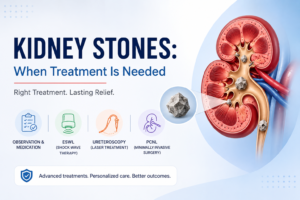
Kidney stones can be surprisingly painful, but not every kidney stone requires surgery.
Some small stones can pass naturally with fluids, pain management and, in selected patients, medication. Others may become stuck in the urinary tract, cause severe pain, block urine flow or be associated with infection. In these situations, active treatment may be necessary.
So, when does a kidney stone need treatment, and which procedure is best?
The answer depends on several factors, including the size, location and type of the stone, symptoms, urinary blockage, kidney function and overall health. A urologist evaluates these factors before recommending observation, medication, ESWL, ureteroscopy or PCNL.
What Are Kidney Stones?
Kidney stones are hard deposits that form when certain minerals and salts become concentrated in the urine and form crystals.
They can range from very small particles to larger stones that may obstruct the urinary tract. A stone can remain inside the kidney without causing symptoms, or it can move into the ureter—the narrow tube connecting the kidney to the bladder.
When a stone blocks urine flow, it can cause the severe pain commonly associated with kidney stones.
What Symptoms Can Kidney Stones Cause?
Kidney stone symptoms can vary depending on the size and location of the stone.
Common symptoms include:
- Sharp pain in the back or side
- Pain spreading towards the lower abdomen or groin
- Pain that comes and goes in waves
- Blood in the urine
- Burning or discomfort while urinating
- Frequent or urgent need to urinate
- Nausea or vomiting
- Cloudy or foul-smelling urine
Some stones cause no symptoms at all and are discovered incidentally during an ultrasound or other imaging test.
Do All Kidney Stones Need Treatment?
No.
A small stone may pass naturally through the urinary tract without a procedure. Depending on the patient’s condition, a urologist may recommend observation, adequate fluid intake, pain relief and, in selected cases, medication to facilitate stone passage.
However, simply waiting is not appropriate for every stone.
Treatment may be recommended when:
- The stone is unlikely to pass naturally
- Pain remains severe or recurrent
- The stone is causing urinary obstruction
- The stone is increasing in size
- There is infection associated with obstruction
- Kidney function may be affected
- The stone causes repeated urinary problems
- The stone remains in the urinary tract despite observation
The decision is based on the individual patient rather than stone size alone.
When Is a Kidney Stone an Emergency?
A blocked urinary system combined with infection can become a serious medical emergency.
Seek urgent medical attention if kidney-stone symptoms are accompanied by:
- Fever or chills
- Severe or worsening pain
- Persistent vomiting
- Difficulty passing urine
- Very little urine
- Feeling extremely unwell
A stone that obstructs urine flow in the presence of infection may require urgent drainage of the urinary system before definitive stone removal is performed.
This is one reason why severe kidney-stone symptoms should not simply be managed at home without medical assessment.
How Are Kidney Stones Diagnosed?
The first step is usually a clinical evaluation followed by appropriate investigations.
Depending on the situation, your urologist may recommend:
Urine tests
Urine testing can help identify blood, infection and other abnormalities.
Blood tests
Blood tests can provide information about kidney function and certain metabolic abnormalities.
Ultrasound
Ultrasound can identify many kidney stones and can also show whether the urinary system is dilated because of obstruction.
CT scan
A non-contrast CT scan can provide detailed information about the size, location and number of stones and may be particularly useful when the diagnosis or treatment plan requires greater precision.
Knowing the exact size and location of the stone is important because these factors influence the choice of treatment.
Kidney Stone Treatment Options
There is no single procedure that is best for every kidney stone.
Modern treatment options include medical management, extracorporeal shock wave lithotripsy (ESWL), ureteroscopy with laser treatment and percutaneous nephrolithotomy (PCNL).
- Medication and Observation
For appropriately selected small stones, active intervention may not be necessary.
The stone may pass naturally while symptoms are managed with medication and adequate hydration, provided there is no concerning obstruction, infection or deterioration in kidney function.
Some medications may help certain patients pass ureteric stones, but they should only be taken under medical guidance.
The patient may be advised to monitor symptoms and return for follow-up imaging to confirm whether the stone has passed or remains in place.
When is observation reasonable?
Observation may be considered when:
- The stone is small
- Symptoms are manageable
- There is no significant obstruction
- There is no infection
- Kidney function is not threatened
- The patient can be appropriately followed up
- ESWL: Shock Wave Treatment for Kidney Stones
Extracorporeal Shock Wave Lithotripsy (ESWL) uses focused shock waves generated outside the body to break a kidney stone into smaller fragments.
The fragments can then pass naturally through the urinary tract.
ESWL can be a suitable option for selected stones, particularly depending on their size, location and composition.
Advantages of ESWL
- No surgical incision
- Non-invasive approach
- Often performed as an outpatient procedure
- Can be appropriate for selected kidney and ureteric stones
However, ESWL does not work equally well for every stone. Stone size, location, composition and the patient’s anatomy can influence its effectiveness.
Sometimes more than one treatment session may be required.
- Ureteroscopy and Laser Lithotripsy
Ureteroscopy (URS) is a minimally invasive procedure in which a thin scope is passed through the natural urinary passage into the ureter and, when required, the kidney.
Once the stone is located, the urologist can remove it with specialised instruments or break it into smaller pieces, commonly using laser energy.
There is no external incision on the abdomen.
Ureteroscopy can be used for stones located in the ureter as well as selected stones within the kidney.
Why is laser ureteroscopy commonly used?
Laser energy allows the surgeon to fragment the stone into smaller pieces or dust-like particles that can be removed or passed naturally.
The exact technique depends on the size, hardness and location of the stone.
Is a stent always required?
Not necessarily.
In some cases, a temporary ureteral stent may be placed after the procedure to maintain urine drainage while the ureter heals or swelling settles.
A stent can sometimes cause temporary urinary frequency, urgency or discomfort. The urologist determines whether a stent is necessary based on the individual case.
- PCNL: Percutaneous Nephrolithotomy
For larger or complex kidney stones, a procedure called Percutaneous Nephrolithotomy (PCNL) may be recommended.
In PCNL, the surgeon creates a small access tract through the skin of the back directly into the kidney. Special instruments are then used to locate and remove or fragment the stone.
PCNL is particularly useful for larger stone burdens and complex kidney stones.
Because PCNL is a more invasive procedure than ESWL or ureteroscopy, the decision requires careful assessment of the stone and the patient’s overall health.
ESWL vs Ureteroscopy vs PCNL: How Are They Different?
| Treatment | How it works | Common role |
| Observation/Medication | Allows selected small stones to pass naturally | Small, uncomplicated stones |
| ESWL | Shock waves break the stone from outside the body | Selected kidney/ureteric stones |
| Ureteroscopy + Laser | Scope reaches the stone through the urinary tract and laser fragments it | Many ureteric and selected kidney stones |
| PCNL | Direct access into kidney to remove/fragment stone | Large or complex kidney stones |
The choice is not based on size alone. Stone location, anatomy, composition, obstruction, symptoms and patient factors all matter.
Which Kidney Stone Procedure Is Best?
There is no universal “best” kidney stone procedure.
For example, a stone that is suitable for ESWL in one patient may be better treated with ureteroscopy in another.
Your urologist may consider:
- Stone size
- Stone location
- Number of stones
- Stone composition
- Urinary obstruction
- Kidney anatomy
- Previous stone treatments
- Infection
- Kidney function
- Other medical conditions
- Patient preference
The objective is to choose the treatment that provides effective stone clearance while keeping the procedure as safe and appropriate as possible.
Can Kidney Stones Be Removed Without Surgery?
Yes, in selected cases.
Small stones may pass naturally without a procedure. ESWL is also a non-invasive treatment that breaks stones using externally generated shock waves.
However, a stone that is large, impacted, obstructing urine flow or causing persistent symptoms may require an endoscopic or percutaneous procedure.
Therefore, “no surgery” is not automatically the safest option. The treatment should be based on the individual clinical situation.
How Long Does It Take to Recover From Kidney Stone Treatment?
Recovery varies according to the procedure.
Patients undergoing ESWL may generally return to normal activities relatively quickly, although passing stone fragments can cause discomfort.
After ureteroscopy, some patients experience temporary urinary symptoms or discomfort, particularly if a stent has been placed.
PCNL generally involves a more significant recovery period because it requires direct access to the kidney.
Your urologist will provide individual instructions regarding activity, hydration, medications and follow-up.
What Happens After the Stone Is Removed?
Removing a stone is only one part of kidney stone care.
If a patient has formed one kidney stone, there may be a risk of forming another in the future.
Depending on the situation, the stone may be sent for analysis to determine its composition. A urologist may also recommend metabolic evaluation, including urine testing, particularly in patients with recurrent stones.
Understanding why a stone formed can help guide prevention strategies.
How Can You Prevent Kidney Stones From Coming Back?
Prevention depends partly on the type of stone.
General measures may include:
Drink enough fluids
Adequate fluid intake helps dilute urine and may reduce the concentration of minerals that contribute to stone formation.
Reduce excessive salt intake
High sodium intake can contribute to increased urinary calcium in susceptible individuals.
Follow an appropriate diet
Depending on the stone type and metabolic findings, dietary advice may involve adjustments to sodium, animal protein, calcium or oxalate intake.
Maintain a healthy weight
A balanced diet and regular physical activity can support overall metabolic health.
Treat underlying causes
Some patients develop stones because of specific metabolic or medical conditions. Identifying and treating these factors can help reduce recurrence.
There is no single kidney-stone diet that is appropriate for everyone. Prevention should ideally be tailored to the patient’s stone type and risk profile.
Frequently Asked Questions About Kidney Stone Treatment
At what size does a kidney stone need surgery?
There is no single size at which every stone requires surgery. The decision depends on the stone’s size and location, symptoms, obstruction, likelihood of spontaneous passage and other patient factors.
Can a 5 mm kidney stone pass on its own?
Some stones around this size can pass naturally, particularly depending on their location. However, the likelihood of passage varies, and the patient should be assessed by a urologist rather than relying on size alone.
Is ESWL better than laser treatment?
Neither is universally better. ESWL and ureteroscopy have different advantages and limitations. Stone size, location, anatomy and other factors help determine which treatment is more appropriate.
Is laser treatment for kidney stones safe?
Laser lithotripsy is an established technique used during ureteroscopy to fragment urinary stones. Like any medical procedure, it has potential risks, which should be discussed with the treating urologist.
Is PCNL only used for very large kidney stones?
PCNL is particularly useful for large or complex kidney stones, although the exact treatment decision depends on the stone burden and patient-specific factors.
Can kidney stones damage the kidneys?
A stone that causes significant or prolonged obstruction can affect kidney function. Infection combined with obstruction can be particularly serious and requires urgent medical attention.
Can kidney stones come back after treatment?
Yes. Removing the existing stone does not necessarily eliminate the factors that caused it. Evaluation of stone composition and, when appropriate, metabolic testing can help develop a prevention strategy.
When Should You See a Urologist?
You should seek medical evaluation if you experience severe or recurrent pain in the back, side or groin, blood in the urine, difficulty passing urine or other symptoms suggestive of a kidney stone.
Urgent assessment is especially important when symptoms are accompanied by fever, chills, persistent vomiting, severe pain or difficulty passing urine.
Early diagnosis can help determine whether the stone can be monitored safely or whether active treatment is required.
Conclusion
Kidney stone treatment has changed significantly, and patients today have several options beyond traditional surgery.
Small, uncomplicated stones may pass naturally with appropriate medical management. When active treatment is needed, options such as ESWL, ureteroscopy with laser lithotripsy and PCNL allow urologists to treat stones according to their size, location and complexity.
The most appropriate procedure is not necessarily the most aggressive one. It is the treatment that offers the best balance between effective stone clearance, safety and the patient’s individual circumstances.
If you have been diagnosed with a kidney stone, a consultation with an experienced urologist can help determine whether treatment is actually needed and, if it is, which procedure is most suitable for you.
This article is intended for general information and does not replace an individual consultation, examination or treatment plan from a qualified urologist.