
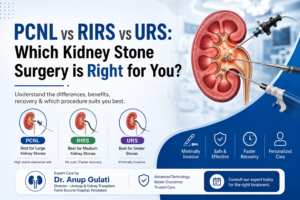
Kidney stones are one of the most common urological conditions, affecting millions of people worldwide. While many small stones pass naturally, larger or obstructive stones often require surgical treatment. Fortunately, advances in minimally invasive urology have made kidney stone surgery safer, more effective, and associated with faster recovery.
If you’ve been advised to undergo surgery, you may come across three commonly recommended procedures: PCNL, RIRS, and URS. Each has specific indications, benefits, and limitations.
In this guide, Dr. Anup Gulati, Director – Urology & Kidney Transplant, explains the differences between these procedures to help you understand which option may be most appropriate for your condition.
Table of Contents
- What Are Kidney Stones?
- When Is Surgery Needed?
- What Is PCNL?
- What Is RIRS?
- What Is URS?
- PCNL vs RIRS vs URS Comparison
- Which Surgery Is Best?
- Recovery After Surgery
- Frequently Asked Questions
- Why Choose Dr. Anup Gulati?
What Are Kidney Stones?
Kidney stones are hard mineral deposits that develop inside the kidneys when minerals and salts crystallize in the urine.
Common symptoms include:
- Severe back or flank pain
- Blood in urine
- Burning while urinating
- Nausea and vomiting
- Frequent urge to urinate
- Fever with chills (if infection is present)
When Is Surgery Needed?
Your urologist may recommend surgery if:
- Stone is larger than 6–8 mm
- Persistent severe pain
- Urinary blockage
- Recurrent infections
- Kidney swelling (hydronephrosis)
- Reduced kidney function
- Failure of medications or shockwave therapy
The choice of procedure depends on:
- Stone size
- Stone location
- Stone hardness
- Number of stones
- Kidney anatomy
- Overall health
What Is PCNL (Percutaneous Nephrolithotomy)?
PCNL is a minimally invasive procedure used primarily for large kidney stones, typically those larger than 2 cm. A small incision is made in the back to access the kidney directly, allowing stones to be fragmented and removed.
Best For
- Stones larger than 20 mm
- Staghorn calculi
- Multiple kidney stones
- Hard stones
- Failed previous treatments
Advantages
- High stone clearance rate
- Effective for very large stones
- Often completed in a single procedure
Limitations
- Small skin incision
- Hospital stay of 1–3 days
- Slightly longer recovery than RIRS
What Is RIRS (Retrograde Intrarenal Surgery)?
RIRS is a completely incision-free procedure. A flexible ureteroscope is passed through the natural urinary passage into the kidney, where a laser breaks the stone into tiny fragments.
Best For
- Kidney stones smaller than 2 cm
- Patients wanting scarless surgery
- Stones in difficult locations
- Recurrent stone disease
Advantages
- No cuts or stitches
- Less pain
- Faster recovery
- Short hospital stay
- Minimal bleeding
Limitations
- Large stones may require staged procedures
- Not ideal for very large stone burdens
What Is URS (Ureteroscopy)?
URS is mainly used to treat stones located in the ureter—the tube connecting the kidney and bladder. A thin scope is inserted through the urinary tract, and laser energy is used to break the stone.
Best For
- Ureteric stones
- Lower ureter stones
- Mid ureter stones
- Upper ureter stones
Advantages
- No external incision
- High success rate
- Day-care procedure in many cases
- Quick return to daily activities
PCNL vs RIRS vs URS: Comparison Table
| Feature | PCNL | RIRS | URS |
| Best Stone Size | >2 cm | <2 cm | Ureter stones |
| Incision | Small | No | No |
| Laser Used | Sometimes | Yes | Yes |
| Hospital Stay | 1–3 Days | 1 Day | Same Day/1 Day |
| Recovery | 1–2 Weeks | 3–7 Days | 2–5 Days |
| Stone Clearance | Excellent | Excellent | Excellent |
| Ideal For | Large kidney stones | Medium kidney stones | Ureter stones |
Which Kidney Stone Surgery Is Best?
There is no one-size-fits-all answer. The most suitable treatment depends on several factors, including:
- Stone size
- Stone location
- Number of stones
- Kidney anatomy
- Previous surgeries
- Infection status
- Overall health
An experienced urologist will evaluate your imaging studies and recommend the most appropriate procedure.
Recovery After Kidney Stone Surgery
Most patients recover quickly after minimally invasive surgery.
General recovery tips:
- Drink plenty of water
- Take medications as prescribed
- Avoid heavy lifting temporarily
- Attend follow-up appointments
- Complete metabolic evaluation if advised to reduce recurrence
Frequently Asked Questions
Is laser surgery better than PCNL?
Laser-based procedures like RIRS and URS are excellent for smaller stones, while PCNL remains the preferred option for larger kidney stones due to its higher stone clearance rate.
Which surgery has the fastest recovery?
RIRS and URS generally allow quicker recovery because they do not require external incisions.
Can kidney stones return after surgery?
Yes. Surgery removes existing stones but does not prevent new ones from forming. Lifestyle modifications, hydration, and metabolic evaluation are essential to reduce recurrence.
Is kidney stone surgery painful?
Modern minimally invasive techniques are performed under anesthesia, and most patients experience manageable postoperative discomfort.
Which surgery is safest?
All three procedures are considered safe when performed by experienced urologists. The safest option depends on your individual stone characteristics and overall health.
Why Choose Dr. Anup Gulati for Kidney Stone Treatment?
Dr. Anup Gulati is an experienced urologist specializing in advanced minimally invasive procedures for kidney stone disease. His approach emphasizes accurate diagnosis, personalized treatment planning, and the use of modern techniques such as PCNL, RIRS, and URS to achieve optimal outcomes while minimizing recovery time.
Patients benefit from comprehensive evaluation, evidence-based care, and guidance on preventing future stone formation.
Key Takeaway
Choosing between PCNL, RIRS, and URS is not simply about selecting the latest technology—it depends on your stone’s size, location, composition, and your overall health. Consulting an experienced urologist ensures that you receive the treatment most likely to provide complete stone clearance with the lowest risk of complications.